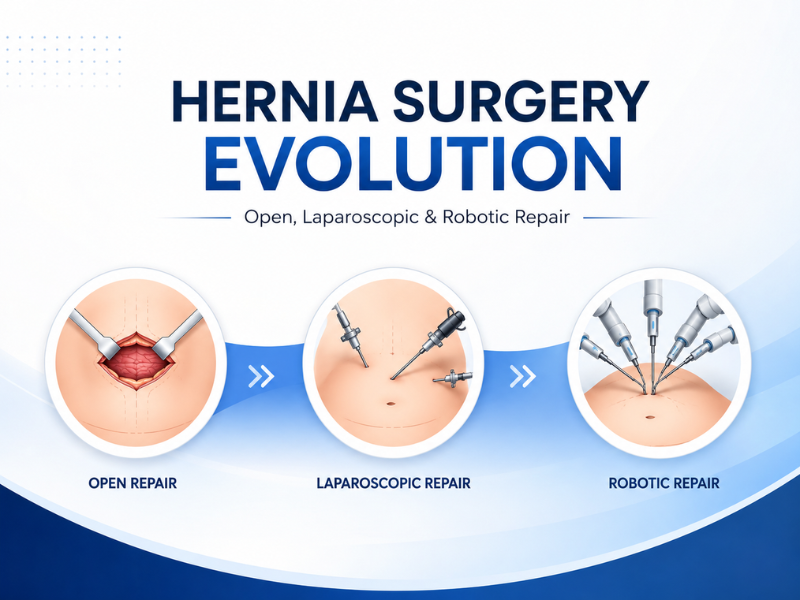
Hernia surgery has changed significantly over the years. Earlier, most hernia repairs were performed through open surgery with a larger incision. Today, laparoscopic and robotic hernia surgery provide minimally invasive options for selected patients.
These advances have changed how surgeons approach hernia repair, with greater focus on smaller incisions, precise surgical techniques, and patient recovery.
If you are looking for hernia surgery in Delhi, understanding how hernia treatment has evolved can help you discuss the right treatment approach with your surgeon.
What Is a Hernia?
A hernia occurs when an internal tissue or part of an organ pushes through a weak area in the surrounding muscle or abdominal wall.
A hernia may appear as a lump or swelling. The swelling can become more noticeable when standing, coughing, lifting, or straining.
Common symptoms may include:
- A visible lump or swelling
- Pain or discomfort
- A feeling of pressure in the abdomen
- Discomfort while lifting or exercising
- Swelling that becomes more noticeable with activity
Some hernias may cause few symptoms, while others can gradually become more uncomfortable. A medical evaluation can help determine the type of hernia and the appropriate treatment.
Open Hernia Surgery: The Traditional Approach
For many years, open hernia surgery was the standard approach for hernia repair.
In open surgery, the surgeon makes an incision over or near the hernia. The hernia is carefully repaired, and the weakened abdominal wall is strengthened using an appropriate repair technique.
Open surgery continues to have an important role in hernia treatment. It may be suitable for certain patients depending on the type, size, location, and complexity of the hernia.
However, traditional open surgery generally involves a larger incision compared with minimally invasive techniques.
The Development of Laparoscopic Hernia Surgery
The introduction of laparoscopic surgery brought an important change in hernia treatment.
Instead of making one larger incision, laparoscopic surgery uses several small openings. A small camera helps the surgeon view the surgical area on a monitor, while specialized instruments are used to perform the repair.
Laparoscopic hernia surgery may be considered for selected types of hernias and patients.
Some potential advantages of a minimally invasive approach may include:
- Smaller incisions
- Less disruption to surrounding tissues
- Smaller scars
- Earlier movement after surgery in some patients
- Recovery that may be easier for some patients
The actual recovery experience varies from person to person and depends on the type of hernia and the surgical procedure.
The Rise of Robotic Hernia Surgery
Robotic technology represents another development in minimally invasive surgery.
During robotic hernia surgery, the surgeon controls specialized instruments using a robotic surgical system. The system can provide a magnified view of the surgical area and allow controlled movement of the instruments.
It is important to understand that the robot does not perform the surgery by itself. The surgeon remains in control throughout the procedure.
Robotic surgery may be useful in selected hernia cases where the surgeon believes the technology can provide advantages for surgical access, visualization, or instrument control.
Open vs Laparoscopic vs Robotic Hernia Surgery
The three approaches have different characteristics.
Open Hernia Surgery
- Uses a larger incision
- Provides direct access to the hernia
- Can be suitable for selected hernias
- Remains an important treatment option
Laparoscopic Hernia Surgery
- Uses small incisions
- Uses a camera and specialized instruments
- Provides a minimally invasive approach
- Can be suitable for selected hernias
Robotic Hernia Surgery
- Uses small incisions
- Uses surgeon-controlled robotic instruments
- Provides magnified visualization
- Allows controlled instrument movements
- May be considered for selected complex or suitable hernia repairs
There is no single approach that is best for every patient.
How Has Hernia Surgery Improved Over Time?
The evolution of hernia surgery is not simply about moving from one technology to another. Surgical techniques have also improved in several other ways.
Better Understanding of Abdominal Wall Anatomy
Modern hernia surgery places greater importance on understanding the abdominal wall and the specific characteristics of each hernia.
This helps surgeons plan the repair according to the patient’s individual condition.
Improved Surgical Visualization
Laparoscopic and robotic systems allow surgeons to view areas that may be difficult to see clearly through a traditional incision.
This can be particularly useful in selected minimally invasive procedures.
More Individualized Treatment
Today, surgeons consider several factors before choosing a surgical approach, including:
- Type of hernia
- Size and location
- Previous surgery
- Whether the hernia has returned
- Abdominal wall condition
- Overall health
- Surgical complexity
This allows treatment planning to be more patient-specific.
Is Robotic Hernia Surgery Better Than Laparoscopic Surgery?
Not necessarily.
Robotic surgery is an advanced form of minimally invasive surgery, but it is not automatically the right choice for every hernia.
For some patients, laparoscopic hernia surgery may be an appropriate option. In selected cases, robotic surgery may provide useful advantages.
The decision should be based on the patient’s condition and the surgeon’s experience rather than choosing a procedure only because it uses newer technology.
When Should You See a Hernia Surgeon?
You should consider a medical consultation if you notice:
- A new lump in the abdomen or groin
- Pain around a known hernia
- Increasing swelling
- Discomfort while lifting or exercising
- A hernia that is becoming more difficult to manage
- A recurring hernia after previous surgery
Early evaluation can help identify the type of hernia and determine whether observation, lifestyle measures, or surgical treatment may be appropriate.
Hernia Surgery in Delhi
If you are considering hernia surgery in Delhi, choosing an experienced surgeon is an important part of your treatment journey.
Dr. Prashant Kumar, General, Laparoscopic and Robotic Surgeon in Delhi, provides surgical consultation and treatment for different types of hernias and abdominal wall conditions.
The treatment approach is selected after evaluating the patient’s condition, medical history, previous surgeries, and other relevant factors.
Patients can discuss open, laparoscopic, and robotic options during consultation and understand which approach may be suitable for their individual case.
Frequently Asked Questions
1. How has hernia surgery changed over the years?
Hernia surgery has evolved from mainly open procedures to include laparoscopic and robotic minimally invasive techniques. Modern treatment also focuses more on individualized surgical planning.
2. Is laparoscopic hernia surgery suitable for everyone?
No. Laparoscopic surgery may be suitable for many patients, but the decision depends on the type, size, location, and complexity of the hernia.
3. What is robotic hernia surgery?
Robotic hernia surgery is a minimally invasive procedure in which the surgeon controls specialized robotic instruments. The technology assists with visualization and instrument movement.
4. Is robotic surgery better than open surgery?
Robotic surgery may offer benefits for selected patients, but it is not automatically better for every case. The appropriate technique depends on the individual patient and hernia.
5. Can a hernia be treated without surgery?
Some hernias may initially be monitored depending on symptoms and individual circumstances. However, a hernia does not always resolve on its own. A surgeon can advise whether surgical treatment is appropriate.
Book a Consultation With Dr. Prashant Kumar
If you are experiencing a hernia, abdominal swelling, pain, or discomfort, getting an expert evaluation can help you understand your condition and available treatment options. Dr. Prashant Kumar is a General, Laparoscopic and Robotic Surgeon in Delhi, offering surgical care for hernia and other abdominal conditions.
To learn more about Dr. Prashant Kumar and his surgical expertise, visit the About Dr. Prashant Kumar page.
For more information and helpful articles about surgical conditions and treatments, explore the Dr. Prashant Kumar Blog.
Book a consultation: 011 3061 1900 / 8178785528
Email: contact@drprasahntkurnarsurgeon.com
Address: Press Enclave Marg, J Pocket, Phase II, Sheikh Sarai, New Delhi, Delhi 110017
Timings: Monday to Saturday, 10:00 AM to 5:00 PM
If you are looking for hernia surgery in Delhi, consult Dr. Prashant Kumar to understand whether open, laparoscopic, or robotic hernia repair may be appropriate for your condition.